
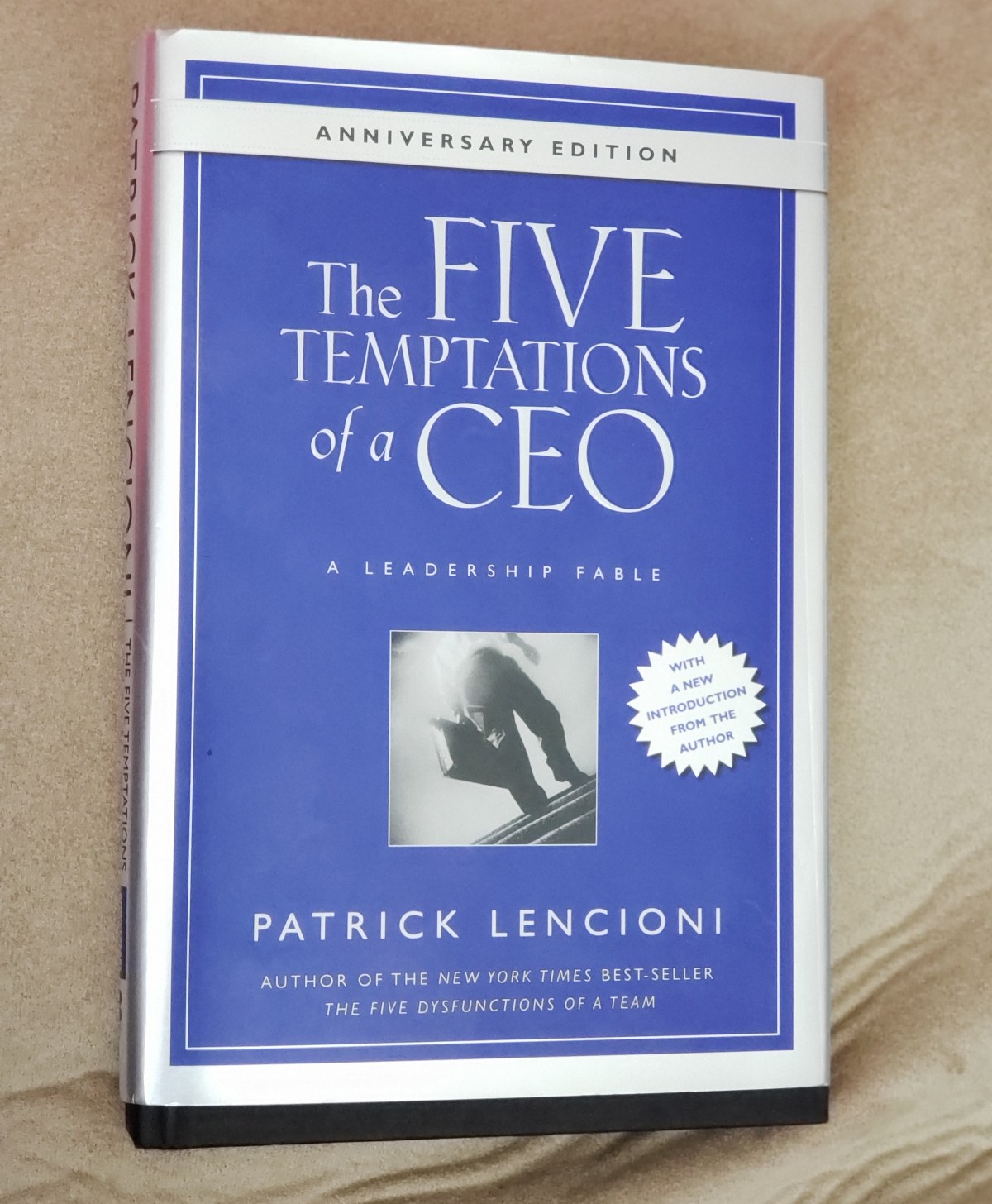
I read somewhere that this book was supposed to be read in one setting and I was not sure if that was going to be true at least for me. Well I guess I was wrong. I read the book in just one setting. Very good read. Very simple, straightforward and the examples that this book uses are right on.
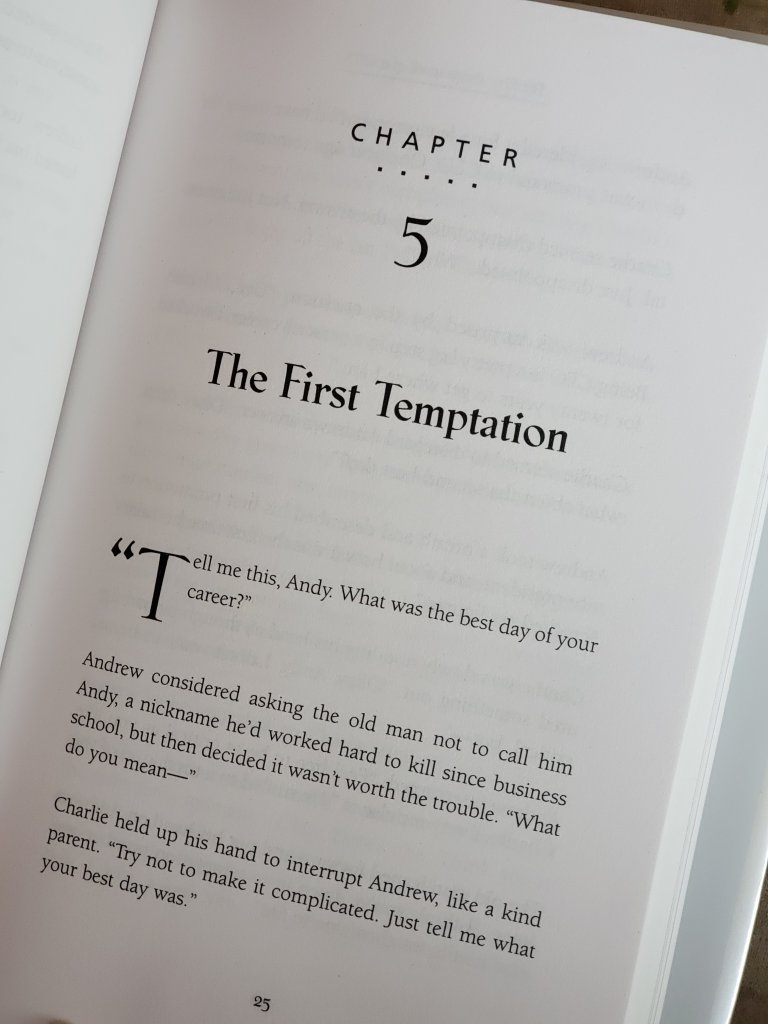
Being the Chief Executive of an organization is one of the most difficult challenges a person can face in a career. But is not a complicated one.
I’m sure that lots of people go through this, may be is a human nature or how society makes us behave but here is a quote about the story the author is narrating about the first temptation. ” Well I can be certain, but it seems to me that you may be more interested in protecting your career status than you are in making sure your company achieve results “. Here is a pretty good question that caught my attention, What was the biggest day of your career? I want you to answer that question but with the book in hand so you can get the full effect of the way you answered that question.
Second temptation:Wanting to be popular with your direct reports instead of holding them accountable.
“Because he told them what he expected and reminded them of those expectations constantly. When they failed, he made the consequences clear, whether it was financial or otherwise. Eventually, if a person could not find a way to improve, they would just leave”.
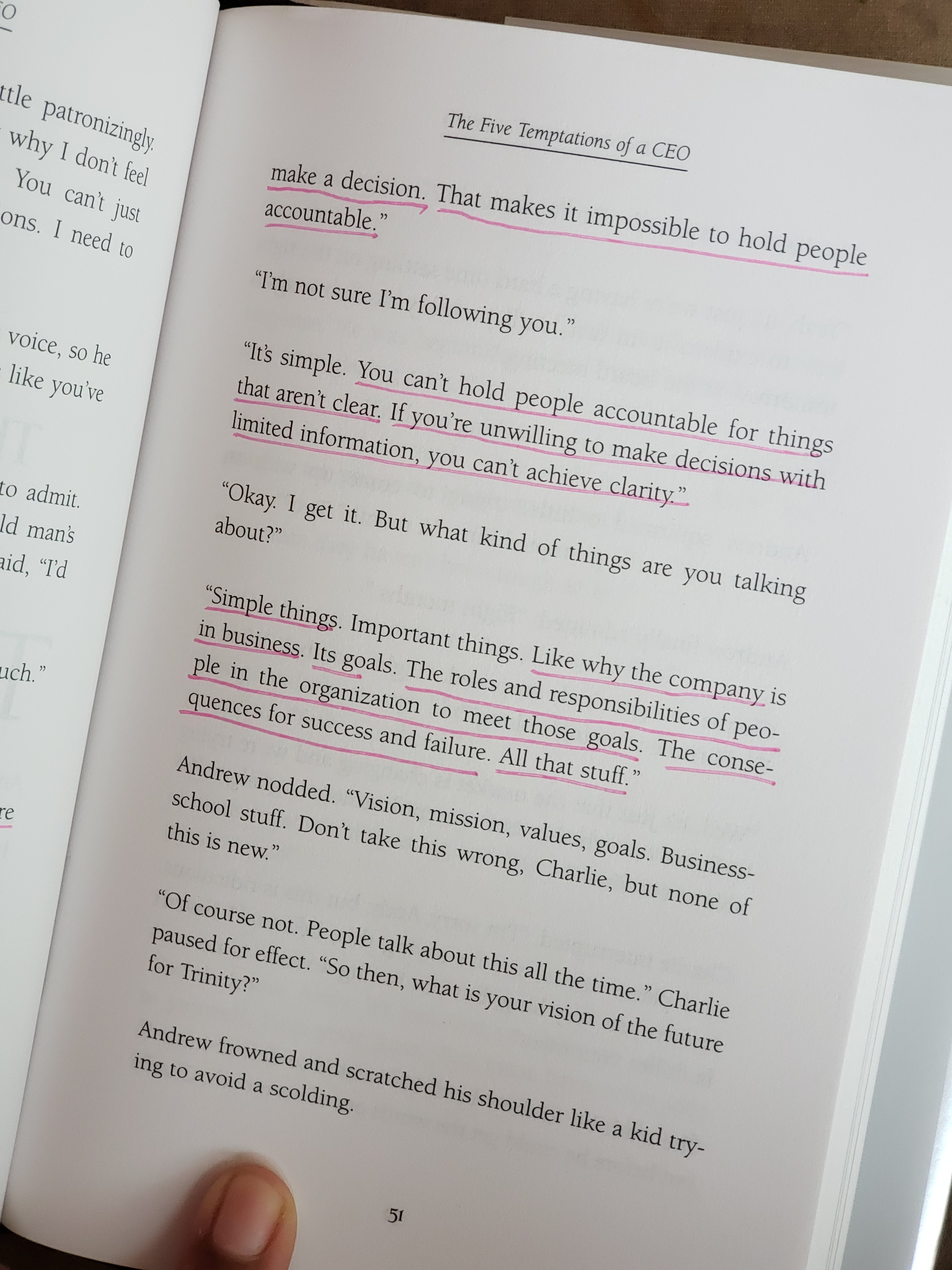
Third Temptation: Its the temptation to ensure that your decisions are correct.” “It’s the temptation to choose certainty over clarity. Some executives fear being wrong so much that they wait until they are absolutely certain about something before they make a decision. That makes it impossible to hold people accountable. “
“You can’t hold people accountable for things they are not clear. If you are unwilling to make decisions with limited information, you can’t achieve clarity. “
In the military they teach you that any decision is better than no decision.
I think that having a great vision and mission is only important if you know how to execute.
The Fourth Temptation is the desire for harmony. What’s the opposite of harmony? Discord, disagreement, conflict. But harmony is cancer to good decision making.
“I don’t have a problem holding people accountable for things, as long as we all agree what those things are.” “And so your decisions aren’t based on all information that your people have to offer.”
The Fifth Temptation, do you know why people don’t trust other people? Because they are afraid of getting burned, that’s what I mean by vulnerability. “

The most important principle that an executive must embrace is a desire to produce results.
Wanting to be liked by peers is an understandable but dangerous, problems for CEOs. Being at a top of an organization is lonely. CEOs have not made it clear what those direct reports are accountable for doing. A simple advice is to make clarity more important than accuracy. Most CEOs believe that is better for people to agree and get along than disagree and conflict with one another. That’s how they are raised. The best decisions are made only after all knowledge and perspectives are out on the table. The best advice is to tolerate discord. CEOs are powerful people. Being vulnerable with their peers and reports is not a comfortable prospect. The simple advice is to actively encourage their people to challenge their ideas. Trust them with your reputation and your ego.
I highly recommend this book and I highly recommend for you to do self assessment. And when you have an opportunity read it again in few weeks and let it sink in.
Other books also by Patrick
The four obsessions of an extraordinary executive
Death by meeting
The three signs of a miserable job
God bless,
Jani

 Let's Be Real Authentic with Janitza